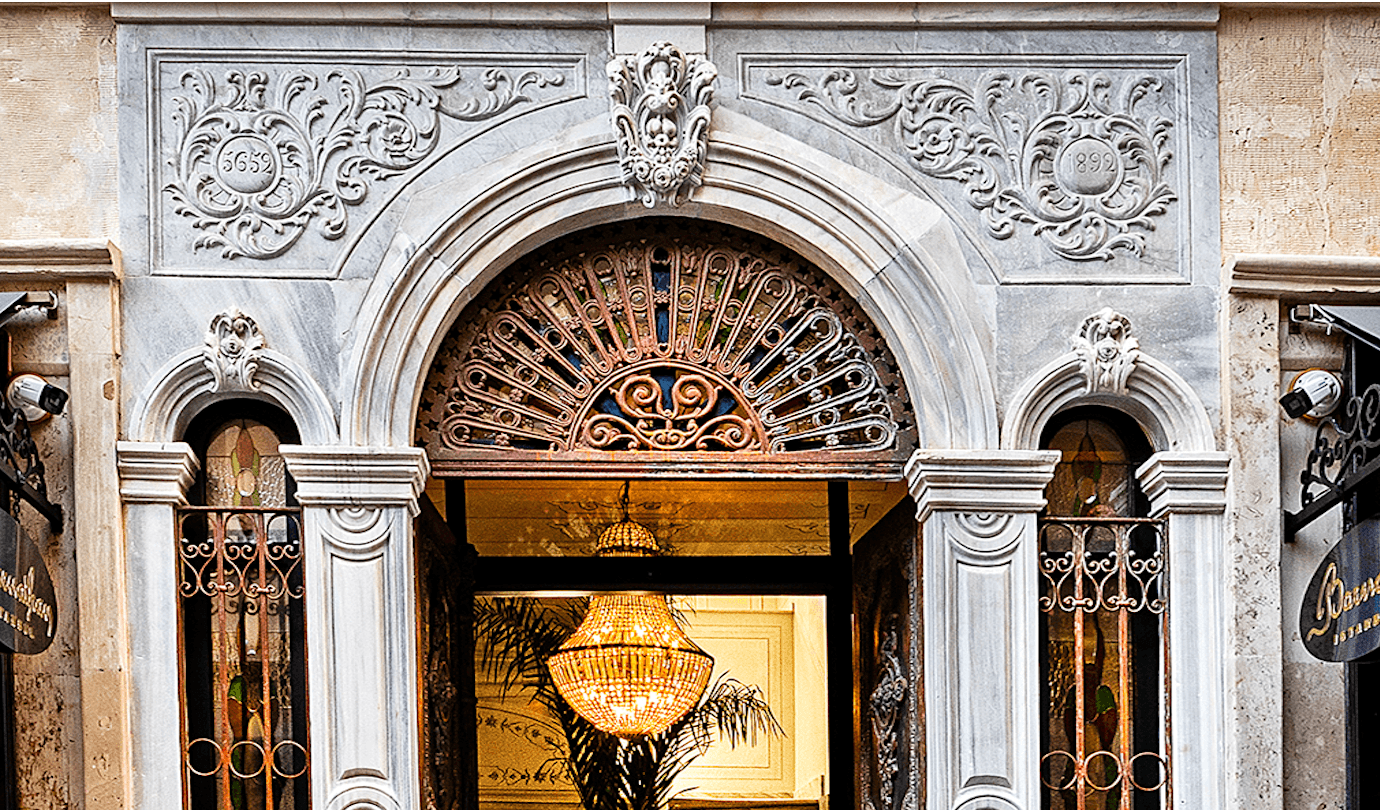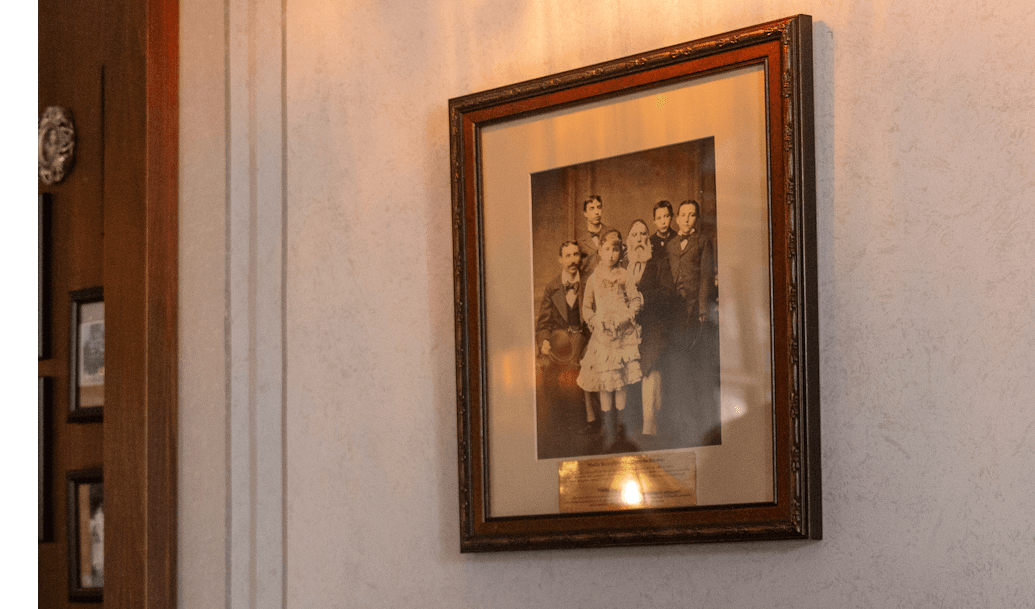
Staying in a historic building is often an abstract statement: you say, “built in 1892,” and the guest nods. But things change when you see the faces of the people who commissioned that building. During research into the story of the Barnathan Apartments, an album belonging to a family scattered across the world was brought together again. The images below are from that album.
The Family
Nissim Barnathan and his children. Nissim (1827–1907), regarded as the elder of the family, was a banker and the owner of Barnathan Han in Eminönü. He had nine children. A newspaper notice published after his death in 1907 spoke of his diligence and open-mindedness despite his devout faith; he had sent his sons and nephews to Europe for their education.
Albert, Louise and Donna Barnathan. All three were born in Istanbul. The youngest, Donna, was born in 1913—a detail that tells us the family was still living in Istanbul at that date. In the photograph, at a period beach with its striped changing cabins, we see the everyday life of Istanbul’s bourgeoisie at the beginning of the twentieth century.
Stella and Moise Barnathan. From the late nineteenth century onward, the family spread across a geography extending from Paris to Nice, and from Buenos Aires to Brazil. These photographs are traces of their Istanbul years before that dispersal. Like many European families, the Barnathans endured their share of the tragedies of the twentieth century; some family members lost their lives during the war years. As you look through this album, it is worth remembering that such a century lies behind every recorded face.
Dr Leon Barnathan’s consulting room in Nice. The family name can be read on the sign at the front. The name of the family that commissioned an apartment building in Galata appears, a few decades later, on a doctor’s door in France—the simplest summary of migration.
Documents
Plan drawn on silk, 15 February 1896. The archive’s most valuable item. Showing every detail and use area of the building, this plan was brought to Istanbul by family member Francis Wacziarg; it had been carefully preserved by his mother and entrusted to him. The signature on the plan belongs to Charles Maruletto, with the title “ingénieur.” Four entrances appear on the plan—yet the section of the building facing Şahkulu Çıkmazı had not yet been constructed in 1896.
Commercial directories, 1893–1898. Published in French, these directories list the apartment building’s first residents door by door: a mirror-maker, a doctor, bankers, and employees of the Ottoman Bank and the Oriental Railways. We now have the list of names from 130 years ago for the apartments whose former residents we wonder about today.
Insurance maps, 1906. They show the street as it was then: a woodshed and wine house on the Tımarcı side (formerly known as Cerrahpaşa), and a pharmacy and grocer’s shop on the corner.
Why are we publishing this?
Because this building is not merely our business; it is the memory of a family. During the research process, family members scattered around the world—from France, the United States, Argentina and India—shared their documents, photographs and stories; the last member living in Istanbul welcomed the researcher into their home and recounted their own story. The resulting study also documented how many times the building’s name changed and how it eventually returned.
Making this archive visible is the least we can do. It is not only stone that has been restored, but memory too.
Images and information: “Barnathan Apartmanları” (Çiğdem Oğuz, Nar Yatırım, 2016). You may consult the book at the Meroddi Barnathan reception.